
Sunday truck ban eased in Germany: low water, replacement haulage, and what brokers should verify
German states are temporarily easing Sunday truck bans due to low water on the Rhine and other rivers. What applies where, why replacement road haulage is involved — and what to check before booking carriers.
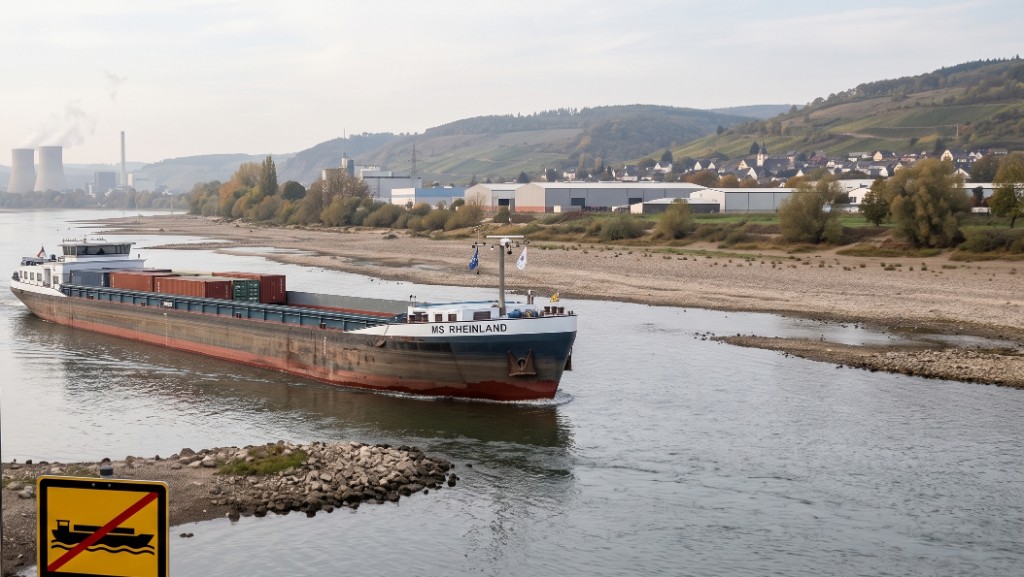
Low water on the Rhine, Elbe, and Danube is squeezing inland shipping to historically weak capacity. Several German federal states are temporarily suspending Sunday truck bans so cargo that would normally move by barge can continue by road. For brokers and shippers, that is not abstract traffic news: it means modal shift, Sunday traffic, and often spot-market pressure.
This article explains what the measure actually means — and why carrier vetting must not slip when booking replacement haulage.
What is happening — and why
River levels are low across much of Germany and Europe. Barges on the Rhine — Europe’s most important inland waterway — often carry only a fraction of their normal load. Less cargo per vessel means higher costs, delays, and shortages of industrial inputs.
To keep supply chains running, goods must temporarily move more by road (and partly by rail). That is replacement haulage: freight that would normally go by inland vessel is catching up by truck.
The catch: in Germany, Sundays and public holidays bring a driving ban for commercial trucks over 7.5 tonnes on most motorways (Road Traffic Regulations § 30) — typically from midnight to 10 p.m. Without an exception, many of these replacement runs could not happen on Sundays at all.
Background: tagesschau — what the easing means, tagesschau — more states join, ADAC — state overview.
What the easing actually means
Important: this is not a general repeal of Sunday truck bans.
| Point | Detail |
|---|---|
| Where | Germany — decided by individual federal states, not EU-wide |
| For whom | Trucks over 7.5 t whose transport is directly or indirectly linked to managing low-water effects |
| Not covered | Heavy/exceptional transports; states without an exception (e.g. Saxony rejected a general easing) |
| Until when | Time-limited — mostly end of August or September 2026; Bavaria, Hesse, and Mecklenburg-Vorpommern partly “until further notice” |
In North Rhine-Westphalia, trucks may also drive on Saturdays during summer holidays — again in the low-water context on the Rhine.
Industry body BGL rightly notes: the easing adds flexibility, not extra driver capacity. Anyone planning replacement haulage still competes for the same trucks and drivers — just on Sundays too.
Europe: shared water problem, different rules
Low water is a European issue: the Rhine, Danube, and Elbe are cross-border waterways. Supply chains along these corridors feel the squeeze across countries.
The Sunday-ban exception is a German emergency measure. Many EU countries have standing Sunday truck bans (France, Austria, Italy, etc.); others do not (e.g. Belgium, Netherlands). There is no EU-wide temporary easing like Germany’s at present.
For international dispatch: the German exception may allow Sunday runs within or through affected states — destination rules abroad still apply separately.
What it means for operations
In practice, many brokers and shippers see:
- Rebooking from barge to road — chemicals, bulk materials, fuel, containers: what no longer moves reliably on water needs truck capacity.
- More Sunday traffic — ADAC expects higher congestion risk at bottlenecks, but not nationwide “traffic chaos”, because rules are narrow and temporary.
- Time pressure remains — customers, production, and OTIF do not wait. Sunday runs become a planning option, not the new normal.
- Spot market under strain — urgent capacity often means unknown carriers from exchanges or networks.
That is where logistics and risk meet — not because the government creates fake carriers, but because urgent modal-shift bookings hit the same weak points as any pressured weekend: little time, high trust, severe consequences when things go wrong.
Vetting replacement haulage: what must not slip
The ban easing does not replace due diligence. On the contrary: Sunday assignments, last-minute carriers, and unfamiliar lanes mirror patterns seen in fake carriers and cargo crime — low water or not.
What teams should watch:
Before assignment
- Is the trip actually covered by the exception? Ops and compliance should be able to document the state-specific justification — not every Sunday run is automatically allowed.
- Verify carrier identity — domain, registry, VAT: does the provider match who they claim to be?
- Insurance and documents — no blind trust in PDFs; confirm with the insurer when unsure.
- Dumping rate + “must leave Sunday” — rock-bottom price plus maximum urgency is a red flag, not efficiency.
At the gate
- Driver, plates, and order number must match.
- Last-minute driver or vehicle changes: stop and re-verify — do not wave through because the slot is tight.
More on typical attack patterns: How to spot fake carriers and Cargo crime in Europe.
Where CarrierCheck24 fits
CarrierCheck24 does not fix low water or congestion. It addresses a different bottleneck: carrier vetting under time pressure.
When replacement haulage triggers extra spot bookings, teams need a process that checks fast and documents the outcome — identity, registry signals, domain — before cargo leaves the yard. When Sunday, holiday season, and supply-chain stress coincide, “check later” is not an option.
- Seconds, not manual research — while dispatch keeps moving
- Audit trail — for internal review and claims
- One standard for brokers and shippers — Monday or Sunday
No tool replaces gate checks. But it closes the gap before assignment — where shortcuts most often happen under pressure.
Short checklist
- Clarify and document the state-specific reason for a Sunday run.
- Vet carriers before assignment — not after an incident.
- No shortcuts with unknown spot-market partners.
- Escalate last-minute driver or plate changes.
- Internal standard — who books replacement haulage, who vets, who documents?
Conclusion
Germany’s Sunday truck-ban easing is a national response to a European water problem: barges carry too little, so roads help temporarily. For logistics that means replacement haulage, tighter capacity, and more Sunday traffic — but no exemption from due diligence when assigning freight.
Teams that take low water seriously plan modal shift and keep carrier vetting on track. Start your next check with CarrierCheck24 — and read how to spot fake carriers early and understand cargo crime in Europe.
Frequently asked questions
- Why was Germany’s Sunday truck ban eased?
- Low water levels are severely limiting inland shipping on the Rhine, Elbe, and Danube. Cargo that would normally move by barge must partly shift to the road — and the Sunday ban would block many of those replacement runs.
- Does this apply across Europe?
- No. Low water affects European waterways, but the exceptions to Sunday driving bans are a German measure — decided by individual federal states under national road-traffic rules, not EU-wide.
- Can all trucks drive on Sundays now?
- No. The exception applies only to trucks over 7.5 tonnes whose trip is directly or indirectly linked to managing low-water consequences. Heavy/exceptional transports are excluded. Rules are time-limited and vary by state.
- What should brokers do when booking replacement road haulage?
- Do not skip carrier vetting under time pressure. If you book unknown spot-market carriers for Sunday runs, verify identity, registry, and insurance systematically — same as any assignment, without shortcuts.